
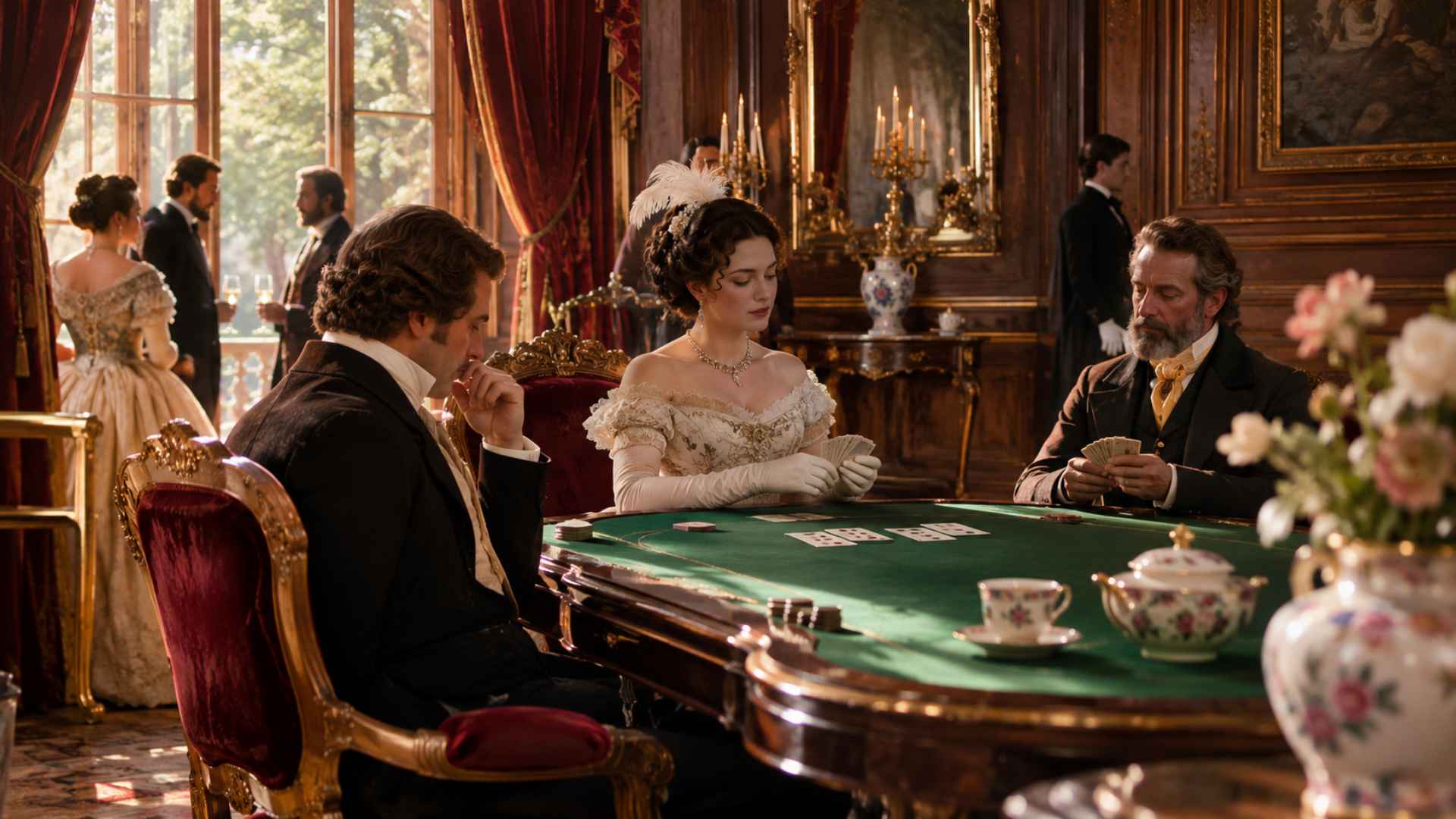
Baccarat has a longer paper trail in nineteenth century Europe than in the Renaissance courts often credited with inventing it. That distinction matters when separating a good story from a documented one. Unlike a mechanical slot machine, this table game developed through people handling cards, putting up a bank, and negotiating the pace of play. Its appeal was social as much as mathematical, which helps explain why its earliest recognizable setting was the private salon.
Many accounts place baccarat in fifteenth century Italy, sometimes attaching the invention to a named gambler. Contemporary evidence for those precise claims is thin. Historians have better records from France, where the game appears in writing during the first half of the nineteenth century. That gap does not disprove an older ancestor, but it means any confident birthday is misleading. The history is best read as a gradual development, not a single dramatic invention.
One likely influence was the family of European banking games in which a dealer’s hand faced hands backed by other participants. Rules traveled between households, clubs, and towns, often changing as they went. Written instructions usually arrived after a pastime was already familiar to its players. For historians of Card Games, this presents an ordinary problem: the surviving text describes a tradition at one moment, not necessarily the moment it began.
Early French Records and the Banker Tradition
The earliest detailed descriptions concern a form later called banque, or à deux tableaux. Two groups of players opposed a single banker, creating three hands in a round. Unlike the modern casino layout, the bank was supplied by a participant rather than automatically funded by the house. That difference shaped everything from the order of play to the amount at risk, and it gave each session a distinct social character.
In these rooms, the phrase Classic Card Game would have meant something different from today’s standardized casino product. Players might bring considerable money, but the attraction also lay in status, etiquette, and knowledge of local conventions. Dealers and participants could make decisions within established limits. Fair Play depended on trust and recognizable procedure, although those standards were not always enforced by the independent oversight associated with regulated gambling today.
The Place of Baccarat in Nineteenth Century Society
French guidebooks and mathematical writing from the 1800s show baccarat becoming recognizable enough to explain and analyze. In the middle of that history sits an interesting language detail: Thai speakers now write the game’s name as บาคาร่า, a reminder that its audience eventually grew far beyond Europe. The original social scene, however, remained comparatively narrow. Access to fashionable rooms often mattered more than knowing every detail of the scoring system.
That system was distinctive. Cards counted largely by their printed values, face cards and tens counted zero, and only the final digit of a total mattered. Hands sought a value close to nine rather than twenty one. Such rules allowed a quick result without making the underlying probabilities obvious. The simplicity of the score concealed difficult decisions in older versions, particularly when someone controlling the bank had room to choose a third card.
From Household Tables to Public Recognition
As gambling moved into more organized venues, private customs began to meet formal house procedures. Written rulebooks could settle disagreements that a host once resolved through authority or habit. The game also acquired a language of fashionable risk, partly because wealthy patrons were visible at certain tables. Yet the idea that every session belonged to royalty is a modern exaggeration. Surviving sources show a changing leisure culture, not one uninterrupted royal tradition.
The early story of baccarat is therefore most credible when it starts with documented French play and leaves room for older, less certain influences. Researchers can trace later changes with much more confidence because newspapers, technical accounts, and casino records become more plentiful. Those sources explain why the banker’s role changed, why some versions survived, and why a salon pastime eventually suited commercial gambling floors without losing its characteristic scoring method.
Today, baccarat carries traces of those older rooms even when the dealer handles everything and the customer only chooses a wager. The name survives, but the relationships at the table have shifted dramatically. Looking closely at that contrast offers more insight than repeating an attractive creation myth. It also shows how a game can retain familiar cards and totals while almost every surrounding custom, from social access to house supervision, changes over time.